

Tips and advice for applying for a blue badge
Your comprehensive guide on how to fill out a disabled blue badge application
What is a blue badge?
If you have a disability, medical condition, or other issue that affects your mobility, you may be entitled to a blue badge. A blue badge is a parking permit that allows people with disabilities of certain health conditions to park their vehicle, or the vehicle they are travelling in, as close as possible to their destination.
It is a government-run programme aimed at supporting individuals with additional mobility requirements. It is issued by local councils and can be used by drivers or passengers with a disability. It generally doesn’t apply to private land or on red routes (a major road with strict no-stopping restrictions).
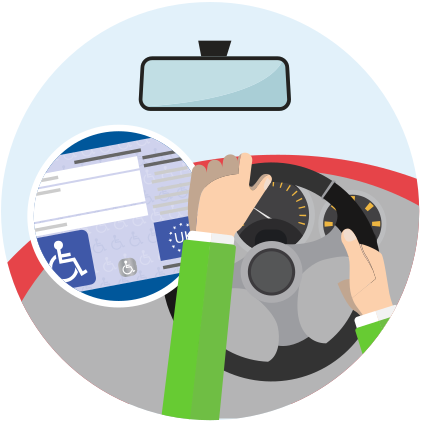
The badge is usually displayed on the car’s dashboard and lets badge holders park in designated disabled bays, on yellow lines (for a limited time) and closer to the shops and services they’re accessing.
What does a blue badge entitle the holder to?
A disability blue badge entitles the holder (or the driver, if they are the passenger) special parking rights to make travel easier, allowing them to park as close as possible to the place they are trying to get to. The exact entitlements vary slightly depending on the local council the individual is in. We recommend checking on the local council’s website before you travel to make sure you know the exact entitlements.

Typically, a blue badge allows the following:
- Parking in designated disabled bays. These may be in car parks or on the street.
- Parking on single or double yellow lines.
- Parking for free without time limits at pay-and-display or metered parking.
- It’s used in any vehicle the badge holder is travelling in.
Here’s what the blue badge does not allow:
- A parking space isn’t guaranteed.
- It can only be used if the badge holder is present in the vehicle, as either a passenger or driver.
- It doesn’t necessarily apply to private car parks (e.g. supermarkets or hospitals).
What medical conditions qualify for a blue badge?
Medical conditions that may qualify for a blue badge include a physical disability that makes walking very difficult or impossible. Other conditions such as disabilities in both arms and hidden disabilities such as dementia or autism may also qualify for a blue badge. Typically individuals who cannot walk more than 50 meters, are registered blind or receive certain disability or war pensions also qualify for a blue badge. If an individuals condition poses a significant risk to health and safety, makes journeys difficult, or means they cannot use a parking meter, they will usually qualify. The individual’s disability must also be considered long term (12 months +).
Some people will automatically qualify for a blue badge. You could automatically qualify if:
- You are registered blind.
- You receive the higher rate of the mobility component of the Disability Living Allowance (DLA).
- You receive PIP (Personal Independence Payment) and got a score of 8 or more in the ‘moving around’ part of the assessment, meaning you were unable to walk more than 50 metres. (If you’re not sure what your score was, check your letter).
- You receive PIP (Personal Independence Payment) and got a score of 10 or more in the ‘planning and following journeys’ part of the assessment, meaning a mental health issue makes it difficult for you to leave home.
- You receive the War Pensioners’ Mobility Supplement.
- You have previously received a lump sum payment from the Armed Forces Compensation Scheme.
If you don’t automatically qualify, you may still be eligible to receive a blue badge if;
- You have a severe or permanent disability or condition that greatly affects your mobility.
- You’re unable to use your arms.
- You have problems with walking that are permanent, or that your doctor has said are likely to last a year or more. This is no longer limited to physical issues, but now includes problems caused by stress, anxiety or other mental health issues.
Local councils are responsible for deciding whether an individual is eligible for a blue badge.
What do I need to apply for a blue badge?
When you apply for a blue badge in the UK you will need to provide personal details, proof of identity, proof of residence, proof of eligibility along with a photograph.
- Proof of identity can be a valid passport, driving licence or birth certificate.
- Proof of residence can be a recent council tax bill or utility bill.
- Your NI number.
- Proof of eligibility will depend on how the individual qualifies for a blue badge. For example, an automatic entitlement could be a PIP award letter, a DLA War Pensioner’s Mobility Supplement or Armed Forces Compensation. If eligibility is assessed then the individual may be required to submit medical letters, test results, prescriptions, hospital records or evidence from specialists or GPs.
- Photographs required are similar to passport photos. A photograph of the individuals head and shoulders, clear background, no obstructions to the face (unless for medical or religious reasons).
- There may also be an application fee. This varies depending on the local council where the individual is applying.
Blue badges can be applied for online via the GOV.UK Blue Badge Service. They can also be applied for through the local council.
What is the blue badge application process?
You can apply online through GOV.UK, or on paper through the post by obtaining a form from your local authority.
You’ll be required to submit supporting documents with your application. This includes:
- Your National Insurance number
- Your driving licence, if you have one
- Your original decision letter from the Department of Work and Pensions, if you are automatically eligible to receive a badge
- Proof of identification e.g. a birth or marriage certificate, a driving licence, a passport or an ID card
- Proof of your address e.g. a letter from your bank or a utility bill
- A photograph of yourself
Obtain copies of these documents and send them with your application.
If you’re not automatically eligible, you will be required to fill out a section on the application form explaining why you need a blue badge. In this section, you should:
- Explain your condition in as much detail as possible
- Describe how your condition affects your daily life and your mobility
- Try to estimate how far you can travel without assistance, how long it takes you to travel this distance and how travelling this distance without assistance makes you feel e.g. if it causes you pain or makes you feel out of breath or dizzy
- You should also include any supporting medical evidence of your condition e.g. a note from your doctor
What to do if my application is rejected?
If your application is refused, you can appeal this decision however, there is no formal appeals process. If you wish to dispute a decision, you can write to your local council, who will deal with the matter internally. They may require you to provide more information or submit new supporting evidence.
Renewing your blue badge
Blue badges usually expire every three years, but this can vary. Renewing a blue badge is a very similar process to applying for one and it can be done online.
It’s recommended to start the renewal process around 8 – 12 weeks before its due to expire, as processing the renewals can take several weeks. If an individual uses a blue badge after expiration, they will be subject to a fine.
You will need the serial number of the old badge, proof of identity, your NI number, proof of residence, proof of entitlement or supporting evidence, a recent passport style photo. As with the first application, there may be a fee for renewing the blue badge.
Blue badge application FAQs
What are the blue badge assessment questions?
Questions will be practical and evidence-based. Examples include:
- How far can you walk without stopping? (e.g. 0-20m; 20-50m; 50-100m; over 100m)
- How long does it take you to walk 40m/100m?
- Do you need to stop and rest? How often and for how long?
- Can you plan and follow a journey independently? What parts are difficult?
- Do you experience severe psychological distress when travelling? Triggers; severity; duration.
- What upper‑limb impairments do you have (strength; range; dexterity)?
- Can you operate pay‑and‑display machines or parking meters? Why not?
- Children under 3: Do they need to be kept near a vehicle for urgent treatment? What treatment; how often; risks if delayed?
- Diagnoses and key dates; expected duration (12+ months).
- Clinicians involved (GP; consultants; therapists); upcoming appointments.
What is the maximum walking distance for a blue badge?
The maximum walking distance for a Blue Badge is often described in terms of not being able to walk more than 50 meters.
Can you get a blue badge for osteoporosis?
You may be able to get a blue badge for osteoporosis, however it depends on how the condition affects your mobility, not the diagnosis itself.
How long does a blue badge application take?
A blue badge application usually takes between 6 to 12 weeks.
Can I track my blue badge application?
Yes, you can track the application online using the reference number provided.
Who can help with blue badge application
Your local council can help with a blue badge application. Advice can also be sought from Citizens Advice or charities such as Age UK.
How do I get an application form for a blue badge?
Blue badge forms can be found online on the GOV.UK website. Some councils may also provide paper versions if you prefer to apply that way.
What are the new rules for a blue badge?
The most recent change to the blue badge scheme in the UK is the extension of eligibility to people with ‘hidden disabilities.’ Hidden disabilities refer to conditions such as autism, dementia, arthritis or extreme anxiety.
Where can you park with a blue badge?
With a blue badge you can park in designated disabled bays. These may be in car parks or on the street. A blue badge also allows parking on single or double yellow lines.
